
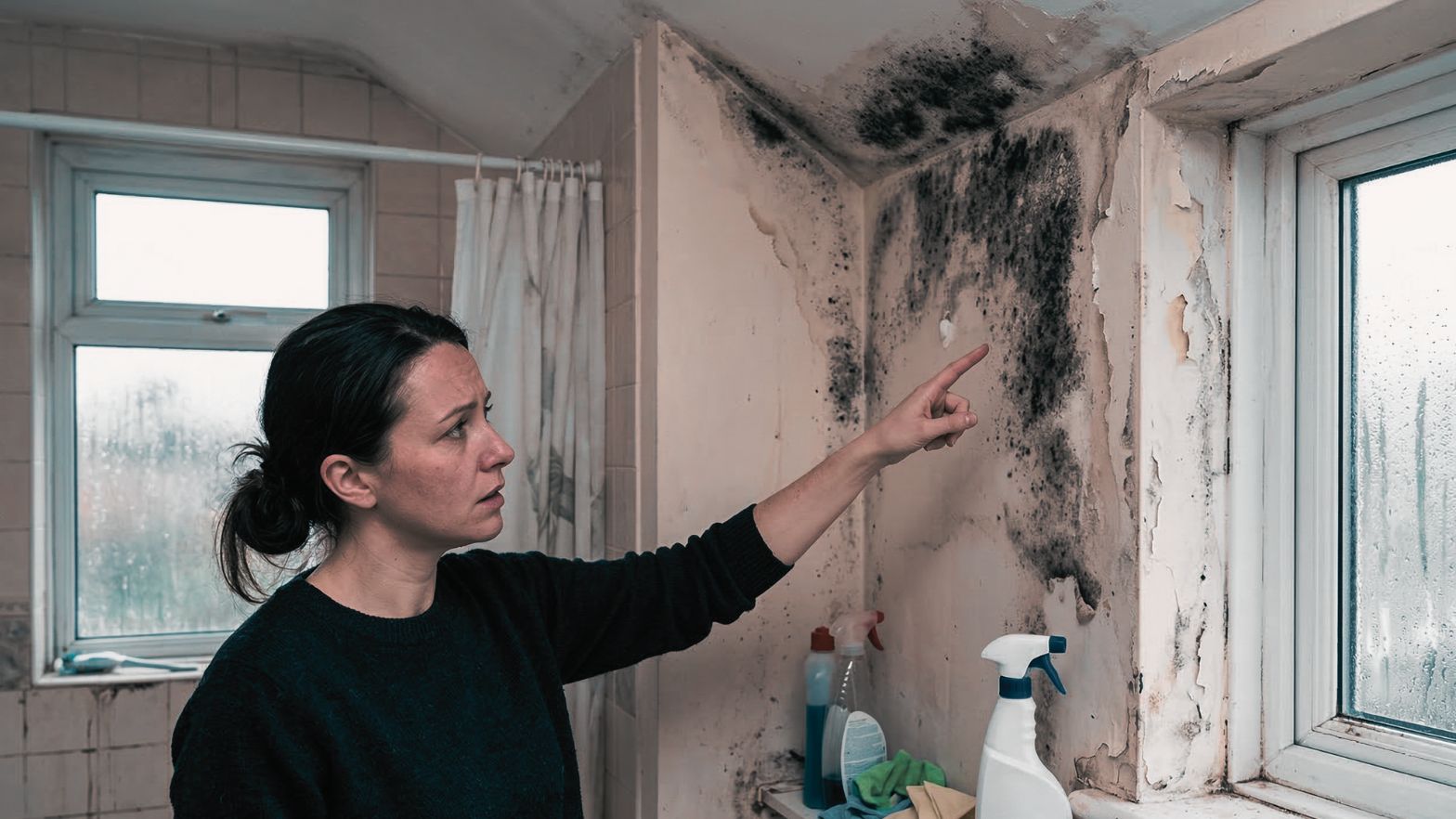
You dealt with the mold. You hired someone. You watched them work. You paid the bill.
And then four months later, there it is again.
Same wall. Same corner. Sometimes the exact same spot, sometimes somewhere slightly different — but unmistakably back. That particular shade of dark. That smell you thought you’d gotten rid of. The whole thing starting over again like the first time never happened.
If this has happened to you, you’re not alone. Mold returning after remediation is one of the most common — and most frustrating — experiences homeowners in New York City deal with. And in almost every case, it’s not random bad luck. There’s a specific reason it came back. Usually more than one.
After years of working in homes and apartments across the Tri-State area, the team at Apex Mold Specialists has seen the same mistakes play out over and over again. Not because homeowners are careless. But because the mold industry has a lot of misinformation floating around, a lot of contractors willing to take shortcuts, and a lot of well-meaning DIY advice that sounds reasonable but misses the point entirely.
Here are the five mistakes that cause mold to return — and exactly what to do instead.
Mistake #1: Treating the Mold Without Fixing the Moisture
This is the big one. The mistake that underlies almost every mold recurrence story.
Mold does not grow because it feels like it. It grows because the conditions in your home support its growth — specifically, because there is moisture present in a place where moisture shouldn’t be. A leaking pipe inside a wall. Condensation forming repeatedly on a cold surface. Water intrusion through a foundation crack. An HVAC system that’s producing more humidity than your space can handle. Inadequate bathroom ventilation that allows steam to saturate the walls after every shower.
These are the actual problems. Mold is what happens because of them.
When a remediation job focuses entirely on removing the visible mold — cleaning surfaces, replacing affected drywall, applying antimicrobial treatments — without identifying and eliminating the moisture source, the job is incomplete. Full stop. It might look complete. The apartment might smell better. Everything visible might be gone. But the conditions that created the mold in the first place are still exactly as they were. And mold, given those same conditions, will do exactly what it did before.
This is why the moisture investigation is not a secondary step in a professional remediation — it’s the primary one. Before any physical remediation work begins, the source of moisture feeding the mold needs to be found and addressed. This sometimes means bringing in a plumber to fix a slow pipe leak. Sometimes it means improving bathroom ventilation. Sometimes it means waterproofing work on a foundation that’s allowing groundwater to seep in. Whatever it is, it has to be resolved — otherwise everything else is just temporary cosmetic work.
If the company you hired to remove your mold never asked you about where the moisture might be coming from, and never took steps to investigate it — that’s why it came back.
Mistake #2: Using Bleach as a Mold Removal Solution
Bleach kills mold. That’s true. It says so on the label and it’s not wrong.
But here’s what the label doesn’t tell you.
Bleach is water-based. When you apply it to a porous surface — drywall, wood, grout, concrete — the active ingredient sits on the surface and kills what’s there. But the water content of the bleach penetrates into the material. And water, as we’ve established, is exactly what mold needs to grow. So you’ve killed the surface colony while simultaneously adding moisture to the substrate beneath it — the place where mold roots, called hyphae, actually live and from which new growth originates.
A week later, the surface looks clean. Two weeks later, new growth is emerging from the same spot. And the homeowner is confused because they cleaned it. Twice.
Bleach also does nothing for mold on non-porous surfaces beyond the immediate visible colony. It doesn’t penetrate. It doesn’t address airborne spores. It doesn’t prevent regrowth. For a very minor, truly surface-level mold situation on a non-porous surface — a bathroom tile, a glass shower door — it has limited use. For anything on drywall, wood, or other porous materials, it is not the right tool.
Professional mold remediation uses EPA-registered antimicrobial treatments specifically formulated to penetrate porous surfaces and address mold at the root level — not just at the surface. These treatments are applied as part of a broader process that includes physical removal of contaminated materials, proper containment to prevent spore spread, and HEPA filtration of the affected area.
The bleach bottle under your sink is not that process. It’s a cleaning product being asked to do a remediation job it was never designed for.
Mistake #3: Skipping the Post-Remediation Clearance Test
Nobody likes spending money after they’ve already spent money. That feeling is completely understandable. You’ve paid for the inspection, paid for the remediation, and now someone is suggesting you pay for a clearance test on top of everything else.
Here’s the problem with skipping it.
The clearance test is the only objective confirmation that the remediation actually worked. It’s not a formality. It’s not an upsell. It’s the step that transforms “we believe the mold has been removed” into “we have laboratory evidence that air quality in this space has returned to acceptable levels.”
Without it, you’re trusting the assessment of the same people who were paid to do the remediation. That’s not an accusation — most remediation companies do good work and their confidence in the result is legitimate. But confidence is not evidence. A visual inspection by the remediation crew is not evidence. The only evidence is a post-remediation air sample analyzed by an accredited laboratory and compared against a baseline.
That evidence matters in ways beyond just your own peace of mind. If you’re a landlord dealing with a tenant complaint, you need documented proof that the issue was resolved — not just the word of a contractor. If you’re selling a property, a clean clearance test result is documentation that has real value in the transaction. If the mold comes back and you find yourself in any kind of dispute about whether the remediation was done properly, the presence or absence of a clearance test report is often the central question.
Apex Mold Specialists provides post-remediation clearance testing as a standard part of their service. They treat it as the necessary final step it actually is — not an optional extra that can be skipped to keep the bill down.
Get the clearance test. Every time.
Mistake #4: Replacing Moldy Materials Without Proper Containment
This one happens more often in DIY situations, but it also happens with contractors who know how to do renovation work but don’t have specific training in mold remediation protocols.
Here’s what occurs.
A homeowner — or a general contractor — discovers mold on a section of drywall. They cut out the affected section and replace it. The visible problem is gone, the new drywall is clean, and the job looks done. What they didn’t account for is what happened during the cutting process.
Cutting into mold-affected drywall releases an enormous quantity of spores into the air. Without physical containment barriers isolating the work area, those spores travel freely throughout the apartment — carried by airflow, by movement, by the HVAC system if it’s running. They settle on surfaces in rooms that previously had no mold problem. They find new moisture sources. They establish new colonies.
You removed mold in one room and created the conditions for mold in three others.
Professional mold remediation requires containment before any physical disturbance of affected materials begins. Heavy plastic sheeting creates a sealed barrier around the work area. Negative air pressure machines ensure that airflow moves into the contained space rather than out of it, preventing spore migration. Workers wear respirators and protective suits and leave them in the contained area rather than carrying contaminated clothing through the rest of the home.
This is not overcaution. It’s the minimum standard required to ensure that remediation in one area doesn’t create new problems everywhere else. Any company — or any DIY approach — that skips containment is not doing remediation. They’re doing construction that happens to involve moldy materials. And the results reflect that.
Mistake #5: Ignoring the HVAC System
Of all the places mold hides in a New York City home, the HVAC system and ductwork may be the most consequential — and the most consistently overlooked.
Here’s why this matters so much.
When mold grows somewhere in your home and spores become airborne, they travel through the air. If your HVAC system is running, it pulls those spores through the return air vents, through the air handling unit, and back out through the supply vents into every room in the apartment. The HVAC system becomes a distribution mechanism — spreading contamination from one affected area throughout the entire living space.
Over time, those spores settle and accumulate on the interior surfaces of the ductwork, on the evaporator coils, in the drain pan, and on the air filter. Even after the original mold source has been remediated, the HVAC system can continue circulating residual spores and, if any moisture is present within the system itself, can become an independent mold growth site.
What this means practically is that you can have a thorough and professionally executed mold remediation in your apartment — walls opened, materials replaced, surfaces treated, clearance test passed — and still have a mold problem, because nobody addressed what was already in the ductwork.
Air duct cleaning and inspection should be part of any comprehensive mold remediation process in a home where the HVAC system has been running during or before a mold event. Apex Mold Specialists offers professional air duct cleaning specifically because they understand this connection — and because leaving the ductwork unaddressed after remediation is one of the most reliable ways to ensure the problem comes back.
While you’re at it — if your apartment has window air conditioning units, those deserve equal attention. Window AC units are notorious for accumulating mold on internal components and then distributing spores directly into the living space every time they run. If mold has been an issue in your apartment during summer months, the AC units are a serious suspect and should be inspected as part of any comprehensive assessment.
The Pattern Behind All Five Mistakes
Reading back through these mistakes, something becomes clear.
Every single one of them is a version of the same fundamental error: treating mold as a surface problem rather than an environmental one.
Mold isn’t just a stain on your wall. It’s a sign that something in your home’s environment — moisture levels, ventilation, building material condition, air circulation — is out of balance. Fixing the stain without fixing the environment is exactly as effective as it sounds. Temporary. Cosmetic. A delay, not a solution.
Real mold remediation — the kind that actually solves the problem rather than postponing it — addresses the full picture. The moisture source. The affected materials. The air quality. The HVAC system. The post-remediation verification. Every component of the environment that allowed mold to establish itself in the first place.
That’s a more involved process than scrubbing a wall and painting over it. It costs more upfront. But it costs significantly less than the alternative — which is doing inadequate work twice, three times, dealing with escalating health consequences, and eventually facing a much larger remediation job than you would have had if the first one had been done properly.
What Proper Mold Remediation Actually Looks Like
At Apex Mold Specialists, the process is built specifically to avoid every mistake on this list.
It starts with a thorough professional inspection — thermal imaging to locate hidden moisture, air sampling to assess spore levels, surface testing to characterize visible growth, and a full assessment of potential moisture sources throughout the space. The inspection drives the remediation plan, which is documented in writing before any work begins.
Remediation follows professional containment protocols — physical barriers, negative air pressure, appropriate PPE. Affected materials are removed and disposed of properly. EPA-registered antimicrobial treatments are applied to affected structural elements. The moisture source is identified and addressed, with coordination with other trade contractors where needed.
After remediation is complete, post-remediation clearance testing confirms that air quality has returned to acceptable levels. The full process is documented in a comprehensive report suitable for legal and non-legal purposes.
And the entire job is backed by a three-year guarantee — because when the work is done right, there’s no reason not to stand behind it.
The Bottom Line
Mold coming back after remediation is not inevitable. It is not bad luck. It is the predictable result of specific mistakes — mistakes that are entirely avoidable when the work is done by people who understand what they’re actually dealing with.
If your mold has returned — or if you’ve never had a proper professional inspection and want to make sure you’re not unknowingly living with the problem — now is the right time.
Call Apex Mold Specialists at 1-800-217-6897 or book your inspection online. Get it done right the first time. Because dealing with mold twice is always more expensive — in every way — than dealing with it properly once.


Comments are closed.