
Living in a New York City apartment is an experience unlike anything else. The energy, the convenience, the sheer density of life packed into every block — it’s what makes this city addictive. But tucked behind that charm is a reality that a surprising number of renters discover only after they’ve already signed the lease and unpacked their boxes.
Not the kind you spot immediately and wipe down with a bleach spray. The kind that’s been quietly growing inside your walls for three months while you kept blaming your allergies on the changing seasons.
I’ve seen it happen more times than I can count. A tenant notices a faint musty smell. Assumes it’s the building. Moves on. Six months later they’re dealing with a full remediation job, a stack of medical bills, and a landlord who swears they knew nothing about it.
You don’t want to be that person. So let’s talk about when mold testing in your NYC apartment actually makes sense — and what you should do about it.
New York City Buildings Are Basically a Mold’s Dream Home
That might sound dramatic, but hear me out.
A massive chunk of NYC’s residential buildings were constructed before 1950. Some of the plumbing in these buildings hasn’t been seriously updated since your grandparents were young. The ventilation? Often an afterthought. The insulation? Not exactly designed for the moisture levels that modern city living generates.
Now throw in the city’s notoriously sticky summers, the condensation that forms on old windows every winter, the fact that your apartment shares walls, floors, and ceilings with multiple other units — and any leak from any one of those neighbors becomes a potential problem in your space.
What makes this genuinely dangerous is that mold rarely announces itself. It doesn’t knock. It doesn’t leave a note. It grows slowly and quietly in the spaces you never look — inside walls, under subflooring, behind bathroom tiles, inside ductwork. By the time there’s a visible sign, it’s often been there a long time already.
This is why “I don’t see anything” is never really a clean bill of health when it comes to mold.
What Mold Testing Actually Looks Like
A lot of people picture mold testing as someone walking around with a flashlight, poking at walls. That’s not it — at least not when it’s done properly.
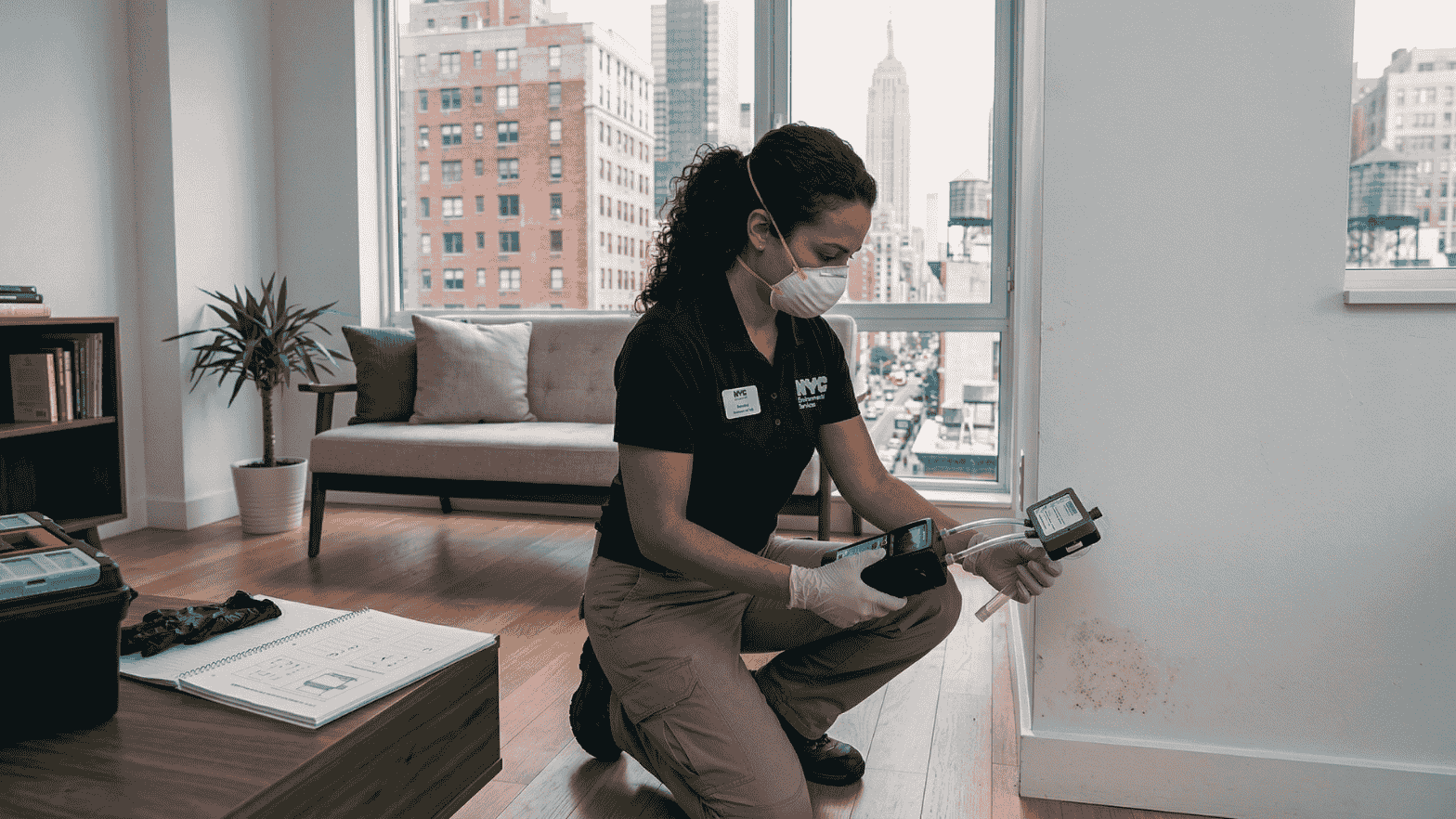
At Apex Mold Specialists, the process starts with a licensed mold inspector doing a thorough walkthrough of the space. Not a general contractor. Not a maintenance worker. A state-licensed professional trained specifically in mold assessment. From there, air samples are collected from inside the apartment and compared against an outdoor baseline. Surface swab samples are taken from any areas of concern. Everything goes to a certified laboratory for analysis.
What comes back tells you the full story — what type of mold is present, how concentrated the spore levels are, and whether what’s in your air falls within a safe range or not.
The part that genuinely surprises most people is the thermal imaging. Apex uses infrared camera technology to detect moisture hiding behind surfaces — inside walls, under floors, above ceilings. You literally cannot see this stuff with the naked eye. But the camera picks up the temperature difference caused by trapped moisture, which is exactly where mold sets up camp. It’s the kind of technology that finds the problem before it becomes a disaster.
And at the end of everything, you get a detailed written report. One that’s professionally documented, clearly written, and built to hold up whether you’re having a quiet conversation with your landlord or walking into housing court.
Five Situations Where You Really Shouldn’t Wait
Water got in — any amount, any reason. A pipe burst. The roof leaked after a storm. The apartment upstairs had a flood and it came through your ceiling. Doesn’t matter how minor it seemed or how fast it dried. Mold starts developing within 24 to 48 hours of water exposure. Surfaces can look and feel completely dry while moisture is still trapped underneath. Test first. Assume nothing.
Your body keeps telling you something is wrong. Persistent cough that won’t quit. Eyes that are constantly irritated. Headaches that seem to ease up whenever you spend a few days away from home. Skin that stays inflamed for no clear reason. These aren’t random. Mold exposure produces symptoms that get misdiagnosed as allergies or viral infections all the time. If your symptoms follow the pattern of your home — worse when you’re in it, better when you’re not — that pattern means something.
Something smells off and you can’t find the source. That damp, stale, slightly earthy smell that some people write off as “just how old buildings smell” — that’s actually the byproduct of active mold growth. The compounds mold releases as it grows create that odor. If you’re noticing it consistently in a specific room or corner of the apartment, something is actively growing nearby. Thermal imaging can locate it even when nothing is visible.
You’re moving into a new place. This is one of the most underused protections available to NYC renters. Getting a professional mold inspection before you move in — before your stuff is inside, before you’re locked into a lease — gives you documentation of the apartment’s condition from day one. If something turns up that the landlord didn’t disclose, you’re in a completely different position legally. It’s a small upfront cost compared to what it saves you.
Mold was already removed, but nobody verified it was actually gone. This scenario is extremely common. A landlord sends someone over, they scrub the visible surface, maybe apply some paint, and call it done. Three months later the mold is back, usually worse. Real remediation means finding and fixing the moisture source, fully decontaminating the affected area, and then conducting clearance testing afterward to confirm the air quality is back to normal. Without that final verification step, you genuinely don’t know if the job was done right.
NYC Law Is Actually on Your Side Here
Under Local Law 55 of 2018, New York City building owners are legally required to investigate and remediate mold in residential units. That means if you’ve reported a mold issue to your landlord and they’ve done nothing, you have real legal recourse — not just a complaint to file and forget.
Where a professional mold inspection report becomes powerful is in that process. A documented assessment from a licensed mold assessor like Apex Mold Specialists gives you concrete, third-party evidence that the problem exists, what type it is, and how severe it is. That’s not something a landlord can easily dismiss — and it carries real weight in any formal complaint or legal proceeding.
Why Apex Mold Specialists Specifically
There’s no shortage of people in New York willing to take your money and tell you your apartment is fine. What makes Apex different is actually pretty straightforward.
Their inspectors hold state licenses both as Mold Assessors and Mold Remediators — a distinction that matters enormously when the documentation needs to stand up legally. Their work comes with a three-year guarantee, which is not something a company offers unless they’re confident in what they’re doing. The technicians are trained through ANDO International, one of the most respected professional training organizations in the environmental services industry.
They also cover the full picture. Water damage, sewage backup, fire damage, biohazard situations — it’s all under one roof. If your mold problem came with a side of flood damage or something worse, you’re not calling three different companies. You’re making one call.
They serve all five boroughs, plus New Jersey and Connecticut, and have been doing this long enough to have encountered every variation of every problem. That kind of experience actually matters when someone is poking around in your home.
The Honest Bottom Line
Mold in a New York City apartment is not a “wait and see” situation. It doesn’t stabilize on its own. It doesn’t improve with a coat of paint. And the longer it goes unaddressed, the more expensive, disruptive, and potentially serious the health consequences become.
If something feels off in your apartment — a smell you can’t locate, symptoms that track with time spent at home, water damage that was never properly followed up on — don’t talk yourself out of getting it checked. The cost of a professional inspection is small compared to what untreated mold ends up costing, in every sense of the word.
Call Apex Mold Specialists at 1-800-217-6897 or book your inspection online. Get the real answers — not a best guess, not a paint job over a problem — the actual truth about what’s in the air you’re breathing every day.


Comments are closed.