
Choosing a mold removal company feels straightforward until you actually start doing it.
You search online. You get a few names. Maybe a neighbor recommends someone. You make a couple of calls. And then suddenly you’re trying to figure out whether the person on the other end of the phone actually knows what they’re talking about — or whether they’re just very confident and very available.
In New York City especially, the mold remediation industry has no shortage of companies willing to take your money. Some of them are excellent. Some of them will do work that looks thorough, costs a lot, and solves nothing. The mold comes back in four months and somehow it’s always your fault — a new leak, a different issue, something that conveniently isn’t covered.
The difference between those two outcomes almost always comes down to the questions you ask before anyone sets foot in your apartment.
This is the list. The real one. Not the sanitized version you find on a company’s own FAQ page.
Question 1: Are You State-Licensed for Both Mold Assessment AND Mold Remediation?
Start here. Don’t skip this one.
In New York State, mold assessment and mold remediation are two separate licensed activities. A Mold Assessor is licensed to inspect, test, and evaluate mold conditions and produce the report that drives remediation decisions. A Mold Remediator is licensed to actually perform the removal and cleanup work.
Why does this distinction matter? Because under New York State law, the same company cannot legally both assess the mold problem and perform the remediation on the same job — unless specific conditions are met. The separation exists to prevent conflicts of interest. An assessor who also profits from remediation has a financial incentive to find problems that may not exist, or to overstate the severity of problems that do.
When you ask a company whether they hold both licenses, you’re not just checking a regulatory box. You’re learning something about how they operate and whether they understand the legal framework that governs this industry in New York.
Apex Mold Specialists holds state licenses for both Mold Assessment and Mold Remediation. Their inspectors are certified professionals operating within the regulatory structure that exists specifically to protect property owners and tenants. That’s not something every company in this space can say.
Question 2: What Does Your Inspection Process Actually Include?
This question separates professional operations from operations that are professional-sounding.
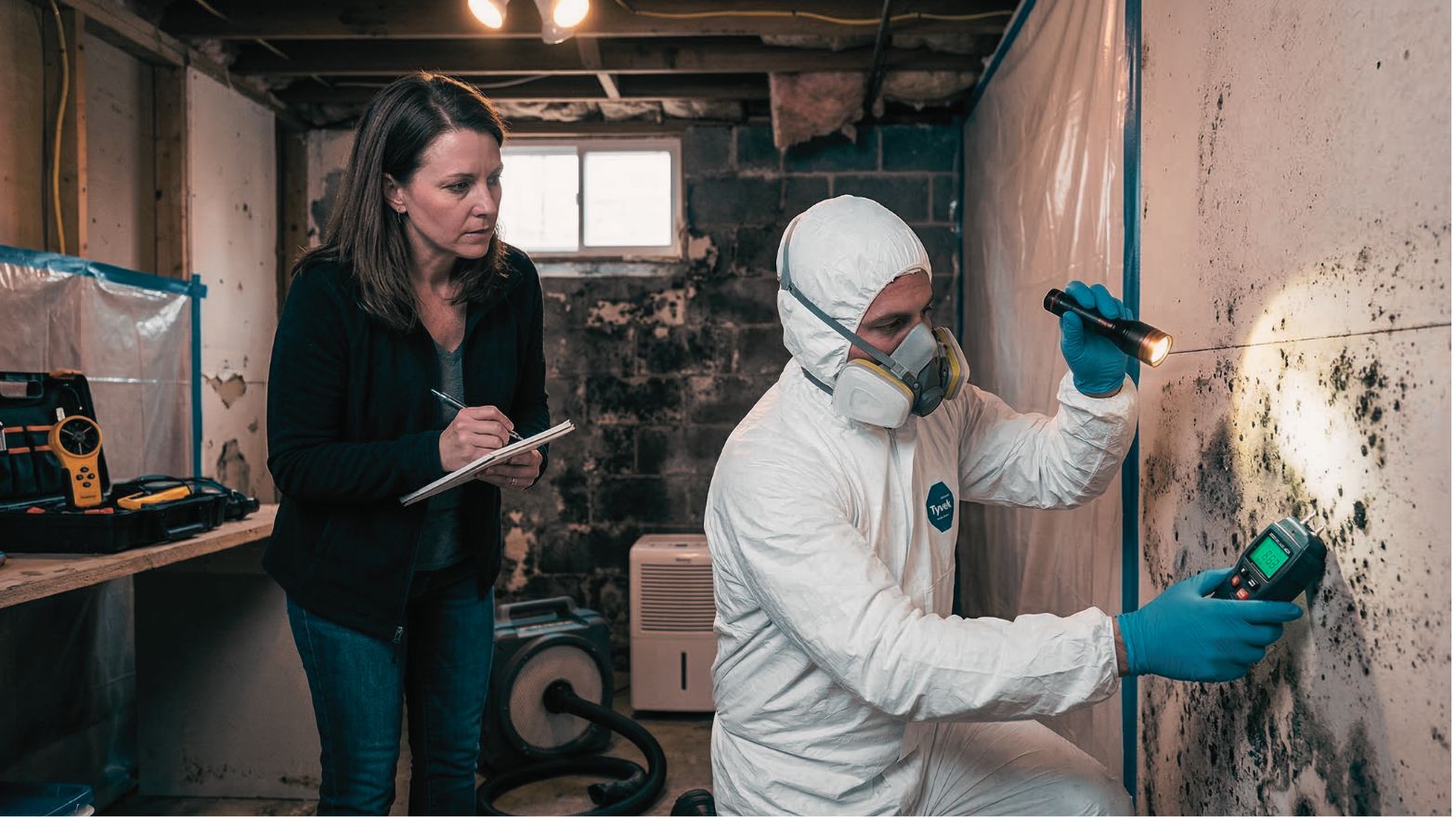
A real mold inspection is not a visual walkthrough. It is not someone walking through your apartment with a flashlight saying “yep, that looks like mold.” It involves air sampling, surface swab collection, laboratory analysis, and — critically — thermal imaging technology to detect moisture and hidden mold growth behind walls, under floors, and inside structural components that are completely invisible to the naked eye.
If a company’s answer to this question is vague — “we look around and take some samples” — that’s useful information. Push for specifics. Ask whether they use thermal imaging. Ask where the samples go. Ask whether the laboratory is accredited. Ask what the report looks like and whether it can be used for legal purposes.
The inspection is the foundation of everything. If it’s not thorough, nothing that follows is reliable. A company that glosses over the inspection process is a company you should think twice about before hiring.
Question 3: Do You Send Samples to an Accredited Laboratory?
The answer to this question should be immediate and confident. Yes, and here’s which lab we use.
If there’s any hesitation, any vagueness, or any suggestion that the company analyzes samples themselves or uses an in-house process — walk away. Mold sample analysis requires accredited laboratory facilities with trained analysts following established protocols. There is no legitimate shortcut to this step.
The laboratory results are what give the inspection its authority. They’re what you use to make remediation decisions, to document conditions for legal purposes, to compare pre- and post-remediation air quality. If those results come from a lab that doesn’t meet accreditation standards, they’re essentially worthless — and you’ve paid for a process that gives you the impression of reliable information without actually delivering it.
Ask the name of the lab. Look it up. Accredited environmental testing laboratories are listed in public directories. This is a thirty-second check that can save you a lot of trouble.
Question 4: Will You Identify and Address the Moisture Source?
Here is where a lot of mold remediation jobs fall apart — and where a lot of property owners end up calling a second company four months after paying the first one.
Mold is a symptom. Moisture is the disease.
Every mold problem has a moisture source. A leaking pipe. Inadequate ventilation. Water intrusion through the foundation or exterior walls. A condensation issue related to an HVAC system. Roof damage that allows water in during rain. If you remove the mold without identifying and fixing the moisture source, you have not solved the problem. You’ve cleaned the symptom while leaving the cause completely intact. The mold will return. It’s not a matter of if — it’s a matter of when.
A professional mold remediation company doesn’t just remove what’s visible. They investigate what caused it. They communicate clearly about whether the moisture source is something they can address directly or something that requires a separate contractor — a plumber, a roofer, a waterproofing specialist. They don’t consider the job done until that source has been dealt with.
Ask this question directly: what is your process for identifying and addressing the moisture source? The answer tells you a great deal about how seriously the company takes the long-term effectiveness of their work.
Question 5: Do You Provide a Written Remediation Plan Before Starting Work?
A reputable mold remediation company provides a written scope of work before any remediation begins. This document should clearly describe what areas are affected, what materials will be removed, what containment measures will be used to prevent cross-contamination during the work, and what the expected outcome looks like.
This matters for several reasons.
First, it protects you. A written plan means there’s a documented record of what was agreed upon. If the company later claims they found additional problems that require additional payment — and this does happen — you have a baseline document to refer back to.
Second, it tells you something about the company’s professionalism. Companies that operate with proper protocols have written procedures. They don’t wing it. They don’t show up with a bottle of bleach and a shop vac and call it remediation. They have a plan, they communicate it clearly, and they execute it systematically.
Third — and this is particularly important for New York City property owners dealing with tenant situations or potential legal matters — a documented remediation plan creates a paper trail. One that demonstrates due diligence, professional process, and responsible action.
If a company resists providing anything in writing before starting work, that resistance is telling you something important.
Question 6: What Containment Measures Do You Use During Remediation?
This one surprises a lot of people. The remediation process itself — the physical removal of mold-affected materials — generates enormous quantities of airborne mold spores. If that process isn’t properly contained, you end up spreading mold contamination to areas of the apartment that were previously clean.
Professional remediation involves physical containment barriers — typically heavy plastic sheeting — that isolate the work area from the rest of the living space. Negative air pressure machines are used to ensure that air flows into the contained area rather than out of it, preventing spores from migrating. Workers wear appropriate personal protective equipment. The contained area is treated with HEPA filtration equipment throughout the process.
If a company’s answer to this question is “we just work carefully” — that’s not containment. That’s a reassurance with no substance behind it.
Ask specifically: what physical containment barriers do you install? Do you use negative air machines? What PPE do your workers wear? A company that does this properly will answer these questions without hesitation because it’s simply part of their standard process.
Question 7: Do You Perform Post-Remediation Clearance Testing?
This might be the single most important question on this list. And it’s the one that gets skipped most often.
Post-remediation clearance testing is air sampling conducted after remediation work is complete — by an independent assessor, not the same company that did the remediation work — to verify that mold spore levels in the treated space have returned to acceptable ranges. It’s the objective confirmation that the work was actually effective.
Without clearance testing, you have no verified evidence that the remediation worked. The area may look clean. The contractor may tell you it’s clean. But without laboratory-analyzed air samples taken after the work is done, “clean” is a subjective assessment made by the same person who was paid to make it clean. That’s not a conflict of interest you want to ignore.
Apex Mold Specialists provides post-remediation clearance testing as part of their comprehensive service offering. The clearance test result is a documented, laboratory-backed confirmation — one that holds up for tenants, landlords, buyers, sellers, and anyone else who needs objective verification that a mold problem has been properly resolved.
If a company tells you clearance testing is unnecessary, or that their visual inspection after the work is sufficient — that answer should end the conversation.
Question 8: Can You Provide References and Proof of Insurance?
Simple. Non-negotiable. And more revealing than it sounds.
A company that has been doing quality mold remediation work in New York City will have references. Real ones. Not just testimonials on their own website — actual clients you can speak with. Ask for references specifically from jobs similar to yours — residential apartments, similar scope, similar type of problem.
Insurance is equally important. Mold remediation involves significant disturbance of building materials and the use of equipment in occupied residential spaces. If something goes wrong — a water line gets nicked, a floor gets damaged, a containment setup fails and spores spread to a neighboring unit — you need to know that the company carries adequate liability coverage. Ask for a certificate of insurance. A professional company will provide one without making you feel like you’ve asked for something unreasonable.
Apex Mold Specialists is fully insured and has been serving New York City property owners long enough to have a substantial track record. That kind of established history matters. It means they’ve been held accountable to real clients over real time — not just a stack of carefully selected online reviews.
Question 9: What Does Your Guarantee Cover and for How Long?
Every mold remediation company says they do great work. The ones that actually stand behind it put that confidence in writing.
A meaningful guarantee in the mold remediation business covers the recurrence of mold in treated areas within a defined timeframe. It tells you that if the same problem comes back after the work has been done properly, the company will come back and address it at no additional cost. It’s a signal that the company is confident enough in their process to be financially accountable to it.
Apex Mold Specialists backs their work with a three-year guarantee. Three years. That’s not a thirty-day warranty designed to expire before the mold has a chance to return. It’s a genuine commitment to the quality and durability of the work — and it should be the standard you hold every other company to when you’re making this decision.
Ask every company you speak with: what does your guarantee cover, how long does it last, and what does the claims process look like? The answers will vary considerably, and those variations tell you a lot.
Question 10: Can Your Report Be Used for Legal Purposes?
For New York City property owners — landlords, building managers, buyers, sellers, and tenants dealing with disputes — this question matters more than most people initially realize.
A mold inspection report from a licensed assessor is a legal document. It can be used in housing court proceedings, in landlord-tenant disputes, in real estate transactions, and in insurance claims. Not all reports are prepared with this use in mind. Some are perfunctory documents that provide basic information but lack the detail, format, and professional standing needed to hold up in a formal proceeding.
Apex Mold Specialists produces fully detailed inspection reports that are specifically prepared for both legal and non-legal purposes. When a tenant files a complaint, when a landlord needs to demonstrate they took appropriate action, when a buyer needs documented evidence of a property’s condition — that report is what makes the difference between having a claim and being able to prove it.
Ask any company you’re considering: are your reports usable in legal proceedings? Are they prepared by a licensed assessor whose credentials can be verified? If the answer is anything other than a clear yes, factor that into your decision.
One Last Thing Before You Make the Call
Finding mold in your New York City apartment or building is stressful. The instinct is to fix it as quickly as possible and move on. That urgency is understandable. But rushing into a decision about who handles the remediation — without asking the right questions — is one of the most common reasons mold problems in NYC apartments end up recurring, escalating, and costing far more than they should have.
Take the time to ask these questions. A company that handles mold professionally will welcome them. They’ll answer clearly, specifically, and without making you feel like you’re being difficult for wanting to understand what you’re paying for.
The questions that make a bad company uncomfortable are exactly the questions worth asking.
Call Apex Mold Specialists at 1-800-217-6897 or schedule your inspection online. Ask them every question on this list. Their answers are exactly what you should be hearing from a mold removal company you can actually trust.


Comments are closed.