
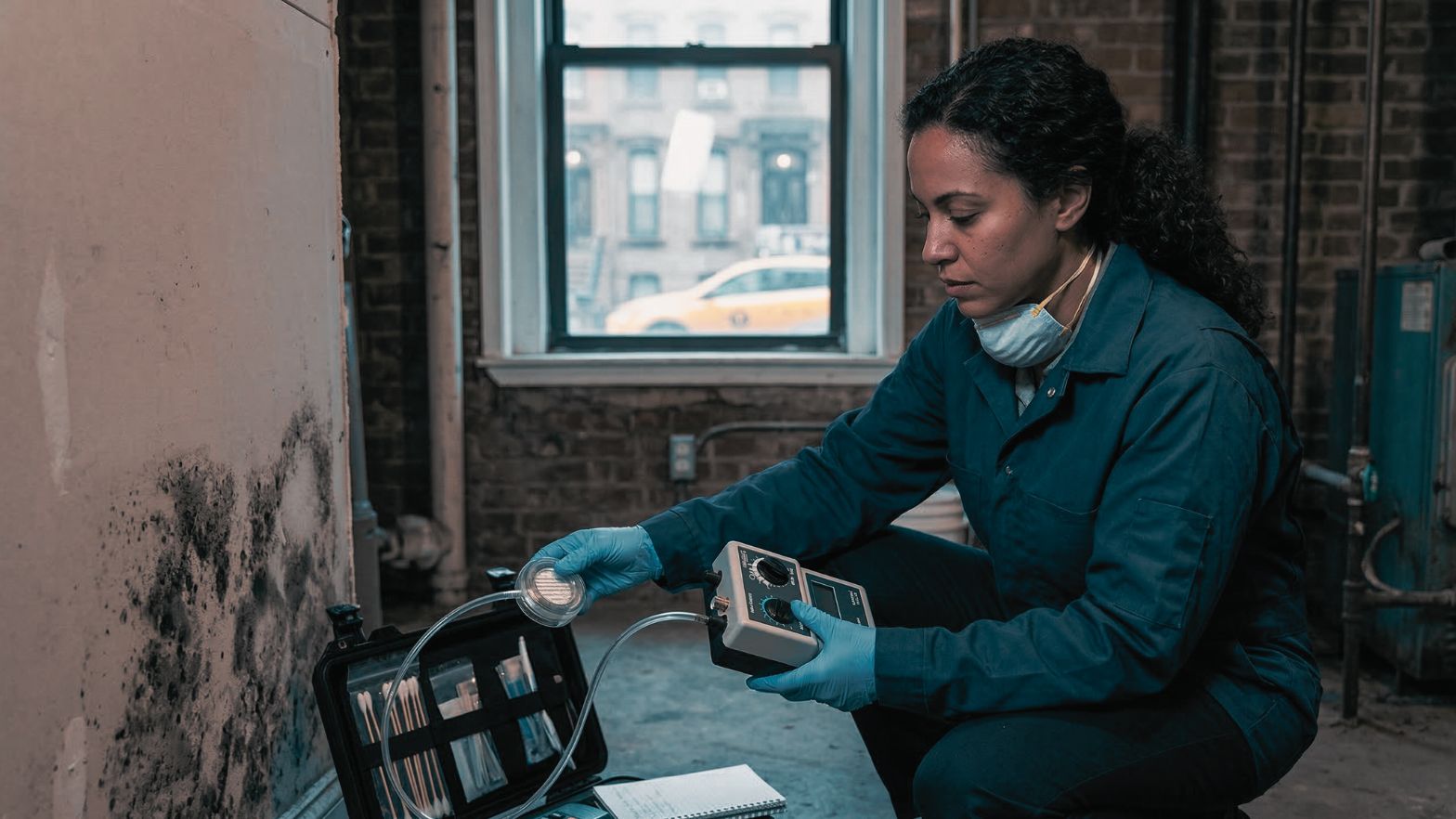
If you’ve ever had a mold test done — or you’re thinking about getting one — there’s a question that almost every property owner eventually asks.
How accurate is this, really?
It’s a fair question. A genuinely important one, actually. Because mold testing isn’t cheap, and the decisions that follow a test result — remediation work, legal action, tenant disputes, renovation plans — can be significant. You want to know that the information you’re acting on is reliable.
The honest answer is: it depends. Not on the technology, which is well-established and scientifically sound. But on who’s doing the testing, how they’re doing it, and whether the right type of test is being used for the right situation.
Let me break this down in a way that actually makes sense for New York City property owners — because the context here matters.
The Different Types of Mold Tests and What They Actually Measure
Not all mold tests are the same. This is probably the most important thing to understand going in, and it’s something a lot of people don’t realize until after they’ve already had work done.
There are three primary types of mold testing used in residential and commercial properties.
Air sampling is the most commonly used method and the one most relevant to health assessment. A pump draws a measured volume of air through a collection device, which is then sent to a certified laboratory. The lab identifies and counts the mold spores present in the sample. The results tell you what’s in the air you’re breathing — which species, and at what concentration.
Surface sampling, also called swab testing or tape lift testing, involves collecting a sample directly from a surface where mold growth is suspected or visible. This tells you what’s growing in a specific location. It’s useful for identifying the species of a visible colony and confirming whether a suspicious stain is actually mold. What it doesn’t tell you is how widespread the problem is or what the overall air quality looks like.
Bulk sampling involves physically removing a piece of material — a section of drywall, a piece of flooring, a tile — and sending it to the lab for analysis. This method gives very detailed information about mold within a specific building material but is more invasive and typically used when there’s already strong reason to suspect contamination within a structure.
The point is this: a surface swab of one visible patch tells you about that patch. It doesn’t tell you what’s behind the wall next to it, what’s growing inside your HVAC system, or what spore levels are doing in the air throughout the apartment. A comprehensive inspection uses multiple testing methods together — not just one in isolation.
What Can Affect the Accuracy of a Mold Test
Here’s where property owners really need to pay attention.
Mold testing, done properly by a trained and licensed professional, is scientifically reliable. The laboratory analysis of collected samples is highly accurate. The technology works.
But the accuracy of the final result depends enormously on factors that happen before the sample ever reaches the lab.
Sampling location matters more than most people realize. Mold spores are not evenly distributed throughout a space. If an air sample is taken in the wrong location — too far from the actual source, or in an area with strong airflow that has diluted the spore concentration — the results will underrepresent what’s actually happening in the apartment. An experienced inspector knows where to sample and where not to. An inexperienced one may collect samples that give a false sense of reassurance.
Conditions at the time of testing affect results significantly. Windows that have been left open for hours before testing can dramatically alter indoor air quality readings by introducing outdoor spores or diluting indoor concentrations. HVAC systems that are running during testing can affect spore distribution. Recent cleaning or disturbance of mold-affected areas can cause a temporary spike in airborne spores. A professional inspector controls for these variables and knows how to interpret results within the context of the conditions present during testing.
The outdoor baseline comparison is essential. Indoor air quality is always assessed relative to outdoor air quality — because mold spores exist naturally outdoors, and some level of spore presence indoors is normal and expected. An accurate mold test always includes an outdoor control sample taken at the same time as the indoor samples. Without that comparison, the indoor results are essentially meaningless. You need to know whether what’s inside your property is significantly elevated relative to what’s outside.
Laboratory quality varies. Not all labs that process mold samples operate at the same standard. Reputable mold testing companies send samples exclusively to accredited laboratories — facilities that follow established analytical protocols and produce results you can genuinely rely on. At Apex Mold Specialists, all samples go to a certified laboratory, which is a non-negotiable part of every inspection they conduct.
The DIY Mold Test Kit Question
Every hardware store in New York City sells them. Those small boxes with a petri dish and an instruction sheet. Test your home for mold in 48 hours. Results you can trust.
Let’s be honest about what those kits actually tell you.
They tell you that mold spores exist in your home. Which is true of virtually every home on earth. Mold spores are present in the air essentially everywhere. The question that matters — the question those DIY kits cannot answer — is whether the type and concentration of mold in your specific indoor environment represents a health risk or an active contamination problem.
A petri dish that grows mold after sitting open in your apartment confirms that the air in your apartment contains mold spores. That’s not useful information on its own. It’s like testing whether your tap water is wet.
What a professional air quality test tells you is the species present, the spore count per cubic meter of air, how that compares to outdoor levels, and whether any of what’s present falls into categories associated with specific health risks or indicative of active hidden growth. That information has clinical and legal meaning. The DIY kit result does not.
For a New York City property owner dealing with tenant complaints, preparing for a sale, managing a building, or trying to understand a health situation in their home — DIY kits are not the answer. They create a false sense of having done something without actually providing the information needed to make good decisions.
How Thermal Imaging Changes the Accuracy Equation
One of the biggest limitations of air and surface sampling alone is that they tell you about conditions at the time of testing. They don’t necessarily reveal where the source of a problem is located.
This is where thermal imaging technology changes everything.
Infrared cameras detect temperature differences in building surfaces that indicate moisture — the primary driver of mold growth. Moisture trapped inside a wall cavity, under flooring, or above a ceiling shows up as a temperature anomaly on the thermal image even when there is absolutely nothing visible from the room.
Apex Mold Specialists uses thermal imaging as a standard component of the inspection process. It’s not an add-on. It’s not optional. It’s part of how they ensure that the testing they’re doing is actually testing the right areas.
Think about it this way. If your air quality test comes back elevated and you don’t know where the source is, you haven’t solved anything. You’ve confirmed a problem without locating it. Thermal imaging closes that gap — it gives the inspector a map of where moisture is active in the building structure, which tells you where to look, where to sample, and where remediation actually needs to happen.
The combination of thermal imaging and laboratory-analyzed air and surface samples is substantially more accurate — and substantially more actionable — than either approach used in isolation.
What Accurate Testing Means for NYC Property Owners Specifically
New York City property owners operate in a specific legal and regulatory environment that makes accurate mold testing particularly consequential.
Under Local Law 55 of 2018, building owners have defined legal obligations around mold in residential dwellings. If a tenant files a complaint about mold, the documentation trail — including any testing that has or hasn’t been done — becomes part of the record. A professionally conducted mold inspection with properly documented results provides clear evidence of what conditions existed at the time of testing. That evidence protects property owners who take appropriate action, and it creates legal exposure for those who don’t.
For property owners involved in sales or purchases, mold testing is increasingly part of the due diligence process in New York City real estate. A clean clearance report from a licensed mold assessor adds credibility and value to a transaction. A discovered mold problem that wasn’t disclosed can result in serious legal liability.
For landlords managing multi-unit buildings, accurate testing is also a management tool. Identifying a moisture problem in one unit before it spreads to adjacent units — above, below, and to the sides — is far less expensive than dealing with a building-wide contamination situation that developed because an early warning sign wasn’t investigated properly.
Post-Remediation Clearance Testing — The Step Most People Skip
Here’s a scenario that plays out regularly in New York City.
A mold problem is discovered. Remediation work is done — either by a contractor hired by the landlord or by a specialized remediation company. The visible mold is gone. The damaged materials have been replaced. Everything looks clean.
And then nobody does a clearance test.
This is a significant mistake. Visible remediation and confirmed remediation are not the same thing. A clearance test — air sampling conducted after remediation work is complete — is the only way to verify that spore levels in the indoor air have actually returned to acceptable ranges. It’s the difference between believing the problem has been resolved and knowing it.
Apex Mold Specialists provides post-remediation clearance testing as part of their full-service offering. The clearance test result is also documented evidence — for tenants, for property owners, for legal purposes, and for anyone else who needs confirmation that the work was done effectively.
Skipping the clearance test is the most common way that mold problems recur without anyone understanding why.
Choosing the Right Testing Company Matters Enormously
Given everything we’ve covered about how accuracy is affected by technique, location, conditions, and laboratory quality — the choice of who conducts your mold inspection is not a minor decision.
In New York City, mold assessors are required to be state-licensed. That license exists for a reason. It means the inspector has completed specific training, passed state examinations, and is accountable to regulatory standards. When you hire a licensed mold assessor, you’re hiring someone whose work is held to a defined professional standard — not someone who watched a YouTube tutorial and bought an air pump.
Apex Mold Specialists holds state licenses for both Mold Assessment and Mold Remediation. Their inspectors are certified professionals. Their laboratory partnerships are with accredited facilities. Their inspection process includes thermal imaging, air sampling, surface sampling, and a comprehensive documented report that is specifically prepared to serve legal and non-legal purposes.
For New York City property owners — whether you’re managing a single apartment, a multi-unit building, or a commercial property — that level of professional rigor is not an luxury. It’s what accurate, defensible, actionable mold testing actually looks like.
The Bottom Line for Property Owners
Mold tests are accurate when they’re done right. The science is solid. The laboratory analysis is reliable. The technology works.
What introduces inaccuracy is cutting corners — using DIY kits that can’t answer the questions that matter, hiring unlicensed inspectors who don’t know where or how to sample, skipping the outdoor control sample, ignoring thermal imaging, and treating a surface swab of one visible spot as a complete picture of a property’s mold situation.
For a New York City property owner, the stakes are too high for that approach. Tenant health, legal liability, property value, and your own peace of mind are all on the line.
Get it done properly, by people who are licensed to do it properly.
Call Apex Mold Specialists at 1-800-217-6897 or schedule your inspection online. Because accurate information is the only kind worth having.


Comments are closed.