
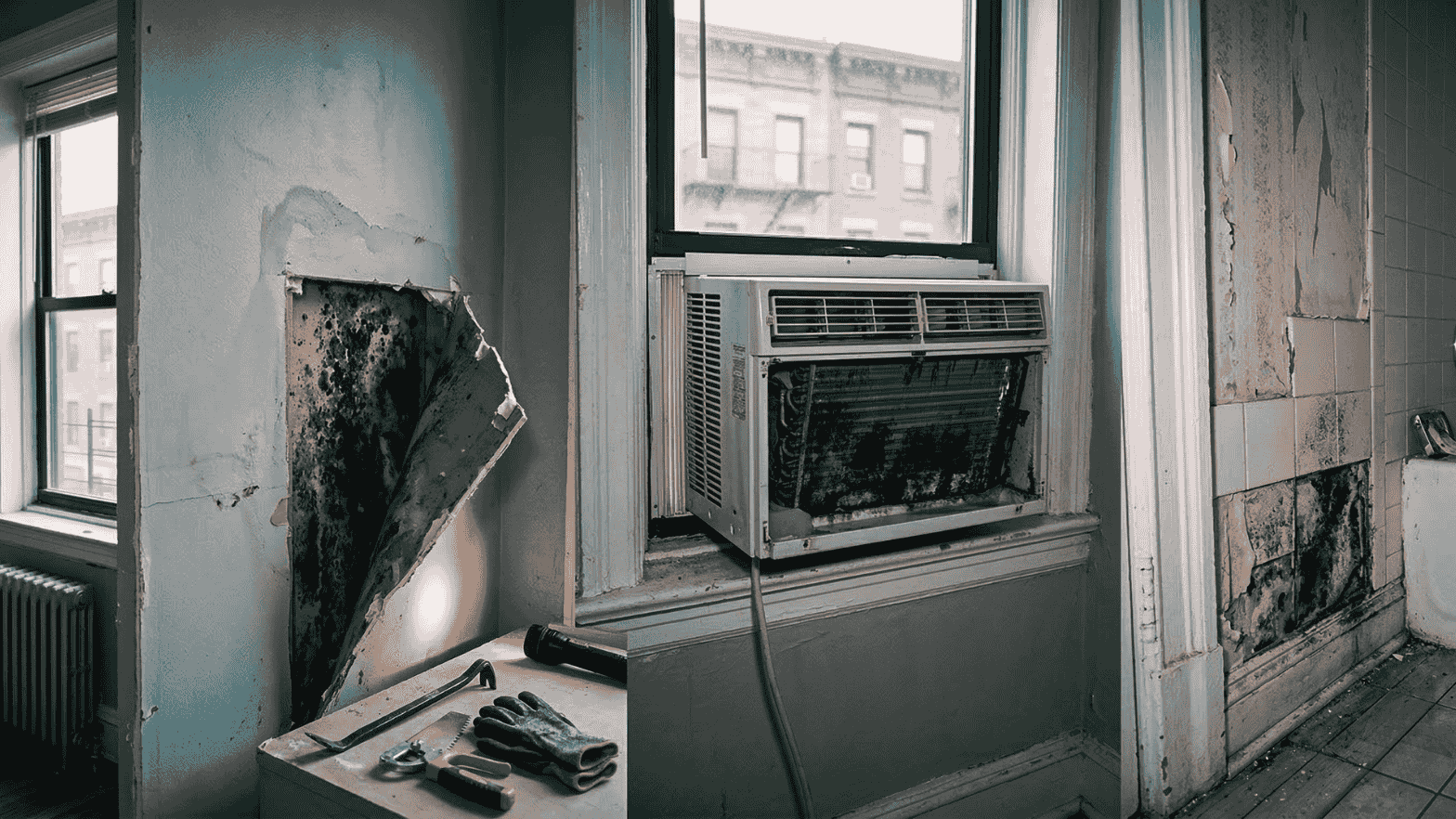
There’s a particular kind of dread that comes with finding mold in your New York City apartment.
Not the small patch near the bathroom faucet that you’ve been meaning to clean. The other kind. The kind you discover when a contractor pulls back a section of drywall during a renovation and the entire interior of the wall is black. The kind where you realize — with a sinking feeling — that you’ve been sleeping ten feet away from it for two years.
That scenario plays out in NYC apartments more often than most people want to admit. And the reason it happens isn’t negligence or bad luck. It’s simply the nature of how mold works in older, densely packed urban buildings. It hides. It grows in the spaces you never look. And by the time it makes itself known, it’s usually been there a very long time.
This is a blog about those hidden places — the spots behind walls, inside air conditioners, and deep in bathroom structures where mold establishes itself quietly and causes real damage before anyone realizes what’s happening.
Why Hidden Mold Is a Bigger Problem Than Visible Mold
Most people’s instinct when they hear “mold problem” is to picture something they can see. A dark stain on a ceiling tile. Discoloration along a window frame. That familiar black growth around bathroom grout.
Visible mold is actually the easier problem to have. You can see it, you know it’s there, you can take action.
Hidden mold is a completely different situation.
When mold grows inside a wall cavity, behind a bathroom vanity, or within the internal components of a window air conditioning unit, it releases spores and mycotoxins directly into your living space — air you breathe around the clock — while remaining completely out of sight. There’s no visual cue. There’s often no obvious smell, at least not immediately. The only signals are frequently health-related, and those get misattributed to a dozen other causes before anyone thinks to check the air quality.
By the time hidden mold is discovered, it has typically spread across a much larger area than surface mold would have in the same timeframe. Because nobody was treating it. Because nobody knew it was there.
That’s what makes it genuinely dangerous.
Behind the Walls — The Most Common Hidden Mold Location in NYC
If you asked a mold inspector where they find the most significant hidden mold problems in New York City apartments, the answer would almost certainly be: inside the walls.
Here’s how it typically happens.
A pipe develops a slow leak — not a dramatic burst, just a gradual seep that loses maybe a cup of water a day. That moisture soaks into the surrounding drywall. The drywall wicks it upward and outward. The wall cavity, which has no airflow and no light, stays perpetually damp. Within days, mold begins to grow on the interior face of the drywall, on the wooden studs, on the insulation. It spreads. Weeks pass. Months pass. The pipe keeps leaking. The mold keeps growing.
From your side of the wall, everything looks perfectly normal.
You might notice the wall feels slightly cool to the touch in one spot. You might see paint that bubbles slightly or wallpaper that won’t stay adhered at one particular corner. You might catch a faint musty smell that seems to come from nowhere specific. These are the clues — quiet, easy to dismiss, completely explainable by other causes.
The only reliable way to confirm what’s happening inside a wall is thermal imaging. Infrared cameras detect the temperature difference between dry building materials and moisture-saturated ones. At Apex Mold Specialists, thermal imaging is a standard part of every mold inspection — because in New York City buildings, what’s happening behind the surface is frequently more important than what’s visible on it.
A wall that looks fine can be harboring a mold colony that covers twenty square feet of interior surface. That’s not hypothetical. That’s a Tuesday in this business.
Inside Air Conditioners — The Hidden Mold Problem Nobody Talks About Enough
Window air conditioning units are everywhere in New York City. Walk down any residential block in July and you’ll see them hanging from virtually every window. They’re a staple of city life.
They’re also one of the most overlooked sources of hidden mold in NYC apartments.
Think about what an air conditioner actually does. It pulls warm, humid air from your apartment, cools it, and recirculates it. In the process, it generates condensation — significant amounts of it — on the internal coils and components. If the unit drains properly and the internal parts stay reasonably clean, that moisture moves through and out of the unit without causing problems.
But most window AC units in New York City apartments do not get the maintenance they need. They get installed in May and removed in October, maybe wiped down on the outside, maybe not. Inside, the evaporator coils, the drain pan, and the air filter become coated with dust, debris, and moisture over the course of a summer. That combination — organic material plus trapped moisture, zero light, minimal airflow — is precisely what mold needs to establish a colony.
What happens next is genuinely alarming. Every time the unit runs, it pulls air through those mold-colonized components and pushes it directly into your living space. You’re not just cooling your apartment. You’re aerosolizing mold spores and distributing them throughout every room the AC reaches.
Children’s bedrooms. Your sleeping area. The living room where your family spends most of its time at home.
The symptoms of AC-related mold exposure often follow a very specific seasonal pattern — people feel worse during summer months when the unit is running, and notice an improvement in fall after it’s been turned off. If that pattern sounds familiar, the air conditioner deserves serious scrutiny.
Getting your AC unit professionally inspected and cleaned, and having your indoor air quality tested if you suspect contamination, is not an overreaction. It’s basic due diligence for anyone living in a New York City apartment.
Bathrooms — More Than Just Surface Mold
Bathroom mold is so common in NYC apartments that a lot of people have started treating it as normal. A little discoloration along the grout. Some dark spots where the wall meets the tub. Standard stuff, right?
Sometimes. But frequently, what’s visible in a bathroom is only a fraction of what’s actually going on.
Bathrooms in New York City apartments are typically small, often poorly ventilated, and get hit with steam and moisture multiple times a day. The exhaust fans — if they exist and actually work — frequently don’t have the capacity to adequately ventilate the space. Moisture accumulates on every surface, seeps into grout lines, penetrates caulk that’s cracked or aging, and works its way into the structure behind the tile.
Behind bathroom tiles, especially in older buildings where the original waterproofing has degraded, is one of the most active mold environments you’ll find in any NYC apartment. The substrate behind tile — typically cement board or, in older buildings, actual wood framing — can be thoroughly saturated and heavily mold-colonized while the tile surface facing your bathroom looks completely fine.
The same applies to the area beneath bathroom flooring. Water that gets past grout lines and the perimeter caulk slowly saturates the subfloor over months and years. In buildings with multiple floors, this moisture can migrate down into the ceiling of the apartment below — meaning your bathroom floor problem becomes your downstairs neighbor’s ceiling problem, and vice versa.
Under bathroom vanities is another classic hiding spot. The area beneath a sink cabinet — especially if there’s been any dripping from the supply lines or drain connections — stays dark, enclosed, and damp. Perfect mold territory. Open the cabinet under any bathroom sink in an older NYC apartment building and take a good look at the back wall and the floor of the cabinet. What you find might surprise you.
The Basement and Ground Floor Situation
If you live in a basement apartment or on the ground floor of an NYC building, you already live with elevated mold risk — whether you know it or not.
Ground-level and below-grade apartments are subject to moisture intrusion from the soil surrounding the building’s foundation. Even in buildings with waterproofing systems, moisture migrates through concrete and masonry over time. Combined with the reduced airflow and natural light that characterizes lower-level apartments, the conditions for hidden mold growth are essentially built into the structure.
Closets on exterior walls in these apartments are particularly vulnerable. The wall surface stays cool, condensation forms regularly, and the enclosed space of the closet maintains moisture levels that the rest of the apartment might not. Items stored in those closets — boxes, clothing, shoes — can develop mold growth on their surfaces while the wall behind them is quietly colonizing.
If you’re in a basement or ground-floor unit and you haven’t had a professional mold inspection, the probability that hidden mold exists somewhere in your apartment is genuinely significant. This isn’t alarmism. It’s the straightforward reality of living at or below grade in an aging urban building.
What Detection Actually Looks Like
Here’s the thing about hidden mold — by definition, you can’t find it by looking. You need tools and training specifically designed for this purpose.
At Apex Mold Specialists, a professional mold inspection for hidden mold involves several layers of assessment working together.
Thermal imaging comes first. The infrared camera scans walls, ceilings, and floors for temperature anomalies that indicate trapped moisture. Any area that reads as abnormally cold and damp gets flagged for further investigation.
Air sampling follows. Samples collected from different areas of the apartment go to a certified laboratory for analysis. The results show not just whether mold is present but what species are in the air and at what concentration — information that matters both for health assessment and for determining the appropriate remediation approach.
Surface swabs are taken from areas of visible concern and from locations flagged by the thermal imaging. These confirm what’s actually growing and help map the extent of the problem.
The combination of these methods creates a complete picture — not a guess, not a visual impression, but documented evidence of what’s actually happening in your apartment’s air and structure.
What Happens After Hidden Mold Is Found
Finding hidden mold is actually the straightforward part. What matters equally is what comes next.
Proper remediation of hidden mold — the kind inside walls, behind tiles, or within HVAC components — is a serious, multi-step process. The affected materials need to be safely removed, the area thoroughly decontaminated, the moisture source identified and fixed, and the space properly dried before any reconstruction begins. Skipping any of these steps is how mold comes back three months later in the same location.
Apex Mold Specialists handles the complete process — inspection, remediation, and post-remediation clearance testing — to confirm that after the work is done, the air quality in your apartment has returned to safe levels. That final clearance test is not optional if you want to be certain the problem has actually been resolved.
If You’ve Never Had Your Apartment Tested, This Is Your Sign
Most New York City apartment residents have never had a professional mold inspection. That’s not a criticism — it simply doesn’t occur to most people until something prompts it.
If your apartment has ever had any water intrusion. If you’re in a building that predates 1970. If your window AC unit is more than a few years old and has never been professionally cleaned. If your bathroom ventilation is inadequate. If you or your family have been experiencing unexplained respiratory symptoms. If you’ve noticed a smell you can’t locate or moisture patterns on walls that keep reappearing.
Any one of those is reason enough.
Call Apex Mold Specialists at 1-800-217-6897 or schedule your inspection online. Because the most dangerous mold in your apartment is the mold you don’t know is there.


Comments are closed.