
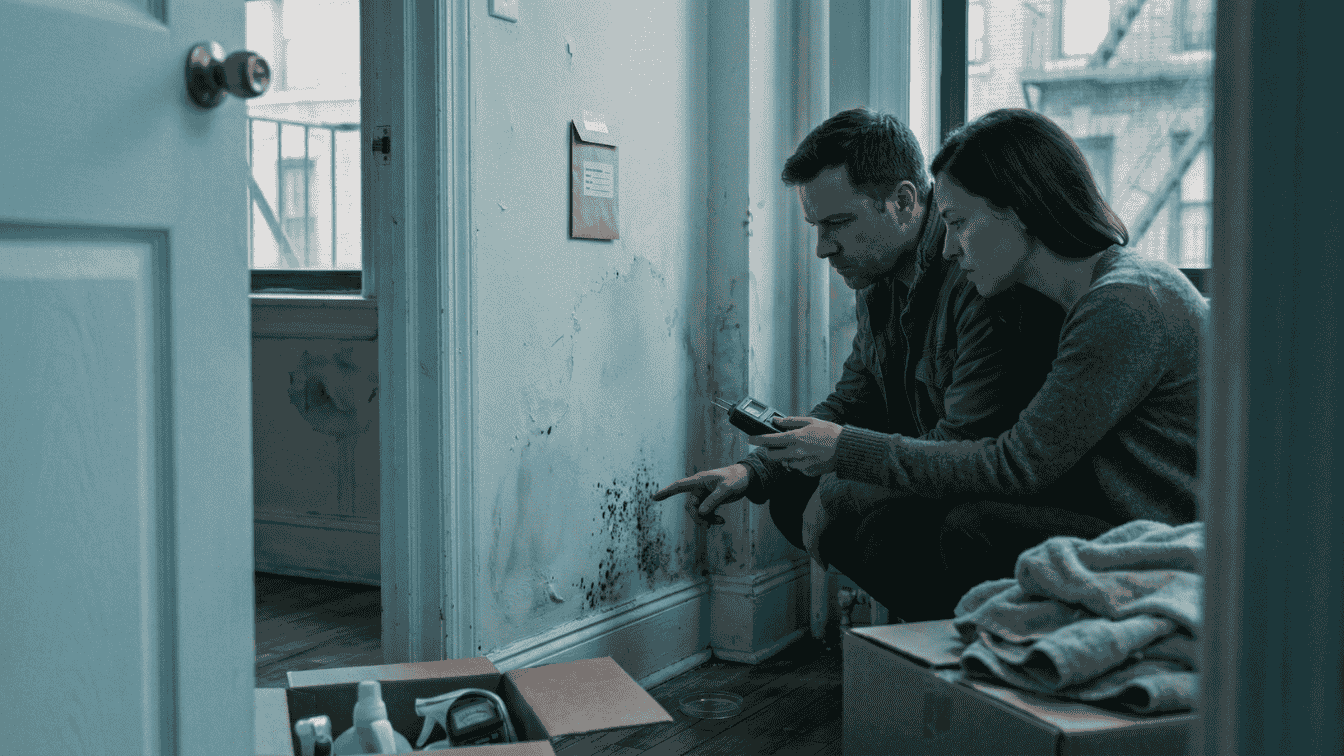
Nobody moves into a New York City apartment thinking about black mold.
You’re thinking about the commute. The square footage. Whether the natural light is actually as good as it looks in the listing photos. Black mold is the last thing on anyone’s mind — until it isn’t.
And when it becomes a problem, it becomes a serious one. Especially if you have kids.
I want to be upfront about something before we go further. Black mold isn’t just an aesthetic issue or a minor inconvenience you can wipe away on a Saturday morning. For families — and particularly for young children — prolonged exposure to black mold in the home carries health risks that are very real, very well-documented, and very much worth understanding before they affect someone you love.
So let’s get into it.
First — What Actually Is Black Mold?
People throw the term around a lot, but it’s worth being specific.
“Black mold” most commonly refers to Stachybotrys chartarum — a particularly toxic variety of mold that thrives in environments with high moisture and low ventilation. It’s dark greenish-black in color, has a slimy texture when wet, and tends to grow on materials with high cellulose content — drywall, ceiling tiles, wood, and the back of wallpaper being the most common culprits in NYC apartments.
What makes it different from the everyday mold you might find on a forgotten piece of bread is the mycotoxins it produces. These are toxic compounds released into the air as the mold grows and spreads. You can’t see them. You can’t smell them specifically. But when you breathe them in consistently over days, weeks, and months — and in an apartment, you absolutely will — they accumulate in the body and start causing damage.
The scary part? A lot of families are living with this right now and don’t know it.
Why NYC Apartments Create the Perfect Environment for Black Mold
Here’s something that doesn’t get talked about enough.
New York City has some of the oldest residential housing in the entire country. Pipes that were installed decades ago. Ventilation systems that were never designed for the way people actually live today. Buildings where one unit’s water problem becomes five other units’ air quality problem before anyone even realizes what’s happening.
Add to that the city’s humid summers, the steam heat that cranks in winter and creates condensation on every surface, the bathroom fans that either don’t exist or haven’t worked since 2008 — and you have a living environment that black mold genuinely loves.
Basement apartments and ground-floor units are particularly vulnerable. So are apartments directly below a rooftop, or units that share a wall with a building stairwell where moisture collects. If your apartment has ever had a leak that wasn’t properly dried and treated within 48 hours — and in NYC, that’s a very large number of apartments — the conditions for black mold growth may already be there.
What Black Mold Does to the Human Body
This is the part that matters most for families.
For healthy adults, consistent black mold exposure typically starts with symptoms that are easy to dismiss. Congestion that won’t go away. A cough that shows up every morning. Headaches that feel vaguely chronic. Fatigue that doesn’t improve no matter how much sleep you get. Skin irritation. Itchy, watering eyes.
The problem is that every single one of those symptoms has a dozen other possible explanations. Seasonal allergies. A cold that’s lingering. Work stress. So people wait. They take antihistamines. They drink more water. They assume it’ll pass.
It doesn’t pass. Because the source is still there, and they’re still breathing it in every single day.
Over time — and “over time” can mean months in a poorly ventilated NYC apartment — more serious effects start to emerge. Respiratory function can genuinely decline. People with asthma find their condition worsening despite medication. Some individuals develop hypersensitivity pneumonitis, a condition where the immune system starts overreacting to the mold spores in a way that mimics pneumonia. In severe cases of prolonged exposure, neurological symptoms including memory problems, difficulty concentrating, and mood changes have been reported.
I’m not writing this to frighten anyone. I’m writing it because these outcomes are real, they’re documented, and they’re almost entirely preventable with early detection.
Children Are in a Different Category Entirely
If there’s one thing I want every NYC parent to take away from this, it’s this: children are not just small adults when it comes to mold exposure. Their bodies respond differently, and the consequences can be more serious.
Here’s why. Children breathe faster than adults — they take in more air relative to their body size, which means they’re inhaling proportionally more airborne spores. Their immune systems are still developing, which means they’re less equipped to fight off the toxic effects. And because kids spend so much time at home — sleeping, playing on the floor, pressing their faces into carpet and couch cushions — their exposure levels in a mold-affected apartment are often significantly higher than an adult who commutes to an office every day.
What does black mold exposure look like in children specifically?
Recurring respiratory infections that keep cycling back. Persistent coughing or wheezing that gets labeled as asthma but doesn’t respond well to treatment. Frequent nosebleeds. Skin rashes without a clear cause. Chronic ear infections. Unusual fatigue or irritability. In some cases, developmental concerns in very young children who have been exposed over a long period.
These aren’t rare edge cases. Pediatricians in New York City see this pattern regularly. The connection between poor indoor air quality and childhood health outcomes is one of the most well-established areas in environmental medicine. And yet so many families are still unknowingly living in apartments where black mold is present and actively affecting their kids.
The Signs You Should Never Ignore
Some signs are obvious. A large, dark, clearly visible patch of mold on a wall or ceiling. Water stains that keep reappearing even after the surface has been painted over. Wallpaper that’s bubbling or peeling without obvious cause.
But honestly? Those are the easy cases. Most black mold situations in NYC apartments are not obvious.
What you’re more likely to notice first is a smell. That distinctive damp, earthy, musty odor — especially in bedrooms, closets, or bathrooms — is often the first sign that something is growing somewhere nearby. A lot of people chalk it up to the building’s age. Don’t. That smell means active growth.
Other less obvious signs include: window frames that stay consistently damp, grout lines that darken faster than they should, wooden floorboards that feel slightly soft underfoot, or walls that feel cool and slightly damp to the touch even in dry weather. If your apartment has any combination of these — especially alongside health symptoms in your family — that’s not a coincidence.
What Professional Testing Reveals That You Can’t See Yourself
This is where a lot of families make a costly mistake. They look around the apartment, don’t see anything obvious, and conclude there’s no mold problem. Or they spot something small, wipe it down with bleach, and consider the matter closed.
Neither of those approaches tells you what’s actually happening in your air.
At Apex Mold Specialists, professional mold testing involves collecting air samples from inside the apartment and analyzing them against an outdoor baseline at a certified laboratory. The results reveal the type of mold present and the actual spore concentration in your indoor air — numbers that have real meaning when it comes to health risk assessment.
The thermal imaging technology Apex uses takes this a step further. Infrared cameras detect moisture trapped behind walls, under flooring, and above ceilings — the exact locations where black mold grows most aggressively and stays hidden the longest. A family can be living with a significant black mold colony growing inside a wall cavity and have absolutely no idea, because there’s nothing visible from the room.
The only way to know for certain what you’re dealing with is to test. Not guess. Not hope. Test.
What NYC Law Says About This
Under New York City’s Local Law 55 of 2018, landlords have a legal obligation to address mold conditions in residential buildings. The law also requires that any remediation work above a certain square footage be performed by a licensed mold remediator — not a regular contractor, not a building handyman.
If you’re a tenant and your landlord has failed to act on a reported mold issue, a professionally documented inspection report from a licensed assessor like Apex Mold Specialists is one of the most powerful tools available to you. It provides third-party evidence of the problem, the severity, and the type of mold involved — documentation that carries real weight in any complaint to the city or legal proceeding.
You have rights. A proper mold inspection helps you exercise them.
Getting the Right Help Makes All the Difference
Not every company that offers mold inspection in New York City is qualified to do it properly. State licensing for both Mold Assessment and Mold Remediation exists specifically because this work has real health and legal consequences — and it should only be done by people who know what they’re doing.
Apex Mold Specialists holds both licenses. Their inspectors are trained professionals, not generalists. Their work is backed by a three-year guarantee. And because they handle everything from the initial inspection through full remediation and post-clearance testing, you’re not left managing multiple contractors and hoping the pieces fit together.
For families with young children especially, getting this right the first time isn’t just important. It’s everything.
The Bottom Line for NYC Families
Black mold is not something to monitor and revisit in a few months. It doesn’t stabilize. It doesn’t get better on its own. And in a New York City apartment — where the conditions for growth are often already present — it can establish itself quickly and quietly before you have any idea it’s there.
If your family has been experiencing unexplained health symptoms, if there’s been any water intrusion in your apartment, if you’re noticing a smell you can’t locate, or if you simply haven’t had your air quality checked and you’ve been living in the same unit for years — it’s time.
Call Apex Mold Specialists at 1-800-217-6897 or schedule online. For your kids. For your family. For the air you all breathe every single day inside the place that’s supposed to be the safest space you have.


Comments are closed.